

AI Agent vs Chatbot vs Automation: Which Actually Protects Your Content?
In 2026, saying your product is 'AI-powered' is like saying your car has wheels. It tells the customer nothing about performance, capability, or reliability. Every SaaS product, every legal tool, every content platform has slapped the AI label on their marketing page. The phrase has been emptied of meaning.
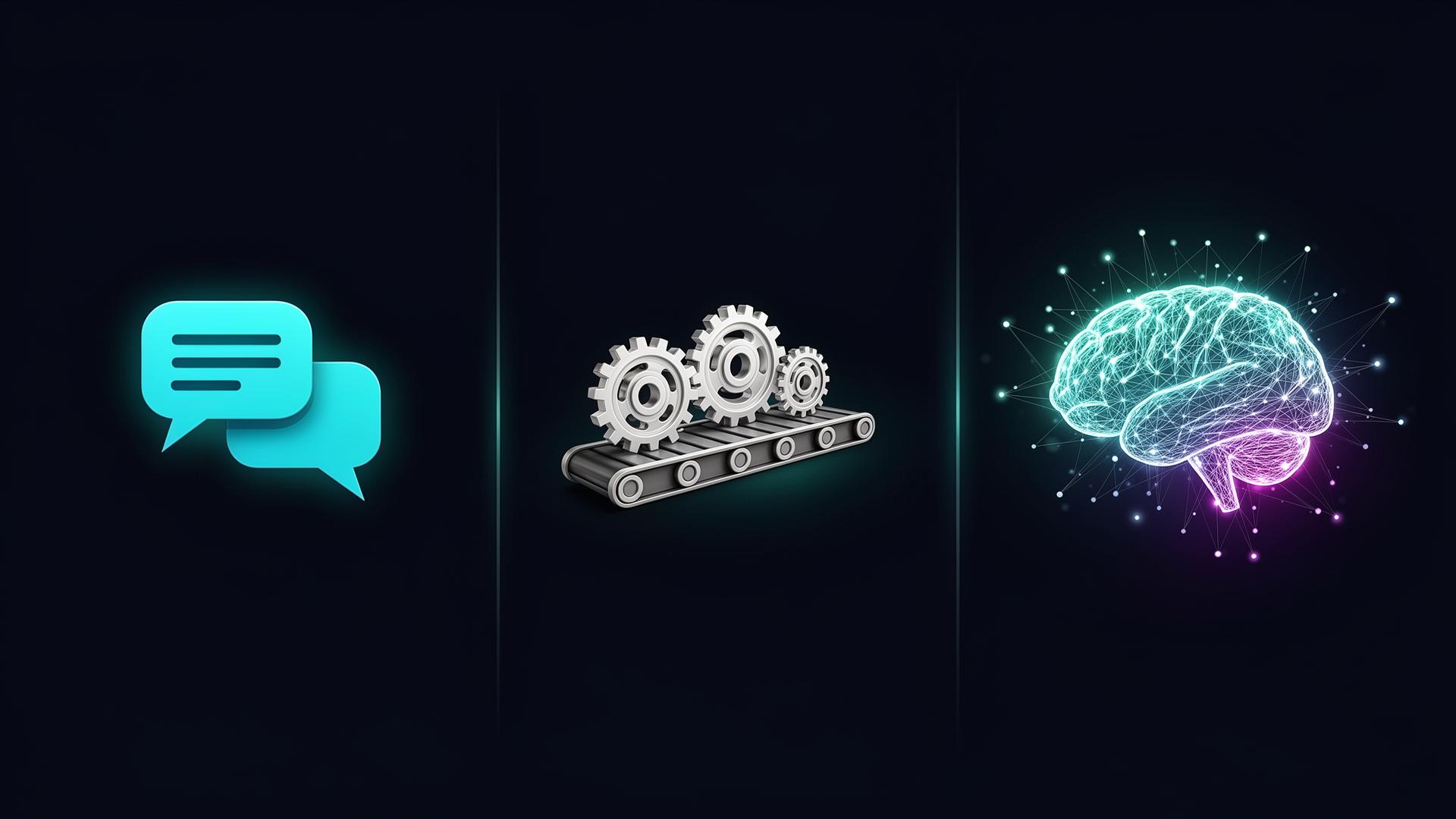
But the technology behind these products varies enormously. There are chatbots that answer questions from a knowledge base. There are automation tools that fill forms and submit them. And there are agents that reason about problems, select strategies, and execute multi-step plans autonomously. These three categories represent fundamentally different capabilities — and in the digital rights space, the difference determines whether your content actually gets taken down.
Understanding these tiers isn't just a technical exercise. It's the difference between spending 45 minutes with a tool that produces a rejected notice and spending 5 minutes with an agent that handles everything from classification to escalation.
The Three Tiers of AI
Tier 1: Chatbots. A chatbot answers questions based on a pre-defined knowledge base or language model. You ask 'How do I file a DMCA notice?' and it explains the process. It might even generate a template. But it doesn't do anything — it informs. The action is entirely on you. You still need to know which template to use, where to send it, how to format it for the specific platform, and when to follow up.
Tier 2: Automation. An automation tool goes one step further — it fills in forms based on your inputs. You provide your name, the infringing URL, and a description, and it generates a completed notice. Some automation tools even submit the notice for you. But the tool doesn't reason about your case. It applies the same template regardless of whether you're dealing with a DMCA issue, a GDPR request, or a deepfake. It doesn't adapt to jurisdictions, platforms, or case specifics.
Tier 3: Agents. An agent receives a goal — 'protect my rights regarding this stolen content' — and reasons about how to achieve it. It classifies the violation type. It determines the jurisdiction. It selects the appropriate legal instrument. It identifies the correct platform and submission channel. It generates a legally compliant notice adapted to the specific context. It routes it. It monitors the response. It recommends escalation if needed. The agent operates with genuine autonomy, making decisions at each step based on the specific facts of your case.
Why the Tier Matters for Takedowns
Digital rights enforcement is not a one-size-fits-all process. The wrong legal instrument means your notice gets rejected. The wrong platform channel means it gets routed to general support instead of the legal compliance team. No follow-up means the platform can quietly ignore your request and face no consequences.
Here's what the data shows: DMCA notices that cite incorrect statutory sections are rejected at roughly 3x the rate of properly formatted notices. Notices sent to general support addresses instead of designated agents take 5-10x longer to process, when they're processed at all. And notices without built-in follow-up — the 'fire-and-forget' approach — result in content remaining online in approximately 40% of cases where the platform's initial response is delayed beyond the standard timeline.
Each of these failure modes corresponds to a tier limitation. Chatbots can't help you avoid these pitfalls because they don't act. Automation tools can't help because they don't reason about which approach to take. Only agents — systems that reason, plan, and execute — can navigate the complexity of multi-jurisdictional, multi-platform digital rights enforcement.
Tired of navigating this alone? Let Pypo's AI agent handle it.
A Real-World Comparison: The Deepfake Scenario
Let's walk through a concrete scenario. Sarah discovers a deepfake intimate image of herself on a website she's never heard of. She wants it taken down immediately.
With a chatbot: Sarah asks 'How do I get a deepfake taken down?' The chatbot explains that she can file a DMCA notice, report to the platform, or contact law enforcement. It might provide template text. Sarah now has information but no action — she still needs to figure out the platform's reporting mechanism, format the notice correctly, determine whether DMCA or the TAKE IT DOWN Act is more appropriate, and submit everything herself. Time spent: 2-3 hours of research and drafting, with uncertain results.
With an automation tool: Sarah fills in a form with the URL and her information. The tool generates a generic takedown notice. But it doesn't know that this specific platform requires TAKE IT DOWN Act citations for deepfake content, that the hosting provider is in a different jurisdiction than the website operator, or that Sarah's state has additional deepfake-specific protections. The generic notice gets submitted but may be rejected for insufficient legal basis. Time spent: 30 minutes, with a meaningful risk of rejection.
With an agent: Sarah describes her situation in plain language. The agent identifies the content as NCII/deepfake, determines the hosting platform and its designated agent, selects the TAKE IT DOWN Act as the primary legal instrument (with DMCA as secondary), adds state-specific deepfake law citations based on Sarah's jurisdiction, generates a legally compliant notice formatted for that specific platform, routes it to the correct intake channel, and sets up monitoring for the 48-hour compliance window. Time spent: 5 minutes. Legally correct notice, properly routed, with built-in follow-up.
The Accountability Gap
There's a dimension that's often overlooked in these comparisons: accountability. When a chatbot gives you information and you act on it, the chatbot bears no responsibility for the outcome. When an automation tool fills a form incorrectly, there's no mechanism for correction. But an agent that tracks responses and monitors deadlines creates a system of accountability — not just for the platform receiving the notice, but for the enforcement process itself.
Under DMCA, platforms must respond 'expeditiously.' Under the TAKE IT DOWN Act, they have 48 hours. Under GDPR, data controllers have one month. These aren't suggestions — they're legal obligations with enforcement mechanisms. But obligations without monitoring are meaningless. An agent that tracks these deadlines and alerts you when they're missed transforms a legal right from theory into practice.
This is the fundamental argument for agentic AI in digital rights: it closes the gap between having rights and exercising them. The law gives you powerful tools. Chatbots tell you about them. Automation tools apply them generically. Agents wield them strategically — with the reasoning, context, and persistence that effective enforcement requires.
Ready to Put Your AI Agent to Work?
See the difference yourself — Pypo's AI agent handles your case from first message to final resolution.
Sources & References
- IBM Research, 'AI Agents vs Chatbots: What's the Difference?' (2024)
- McKinsey & Company, 'Why agents are the next frontier of generative AI' (2024)
- U.S. Copyright Office, DMCA Designated Agent Directory
- Google Transparency Report: Copyright Removal Requests
- Gartner, 'Emerging Tech: The Rise of AI Agents' (2024)
Disclaimer: This article is for informational and educational purposes only and does not constitute legal advice. Pypo is not a law firm. For specific legal matters, consult a qualified attorney in your jurisdiction.